
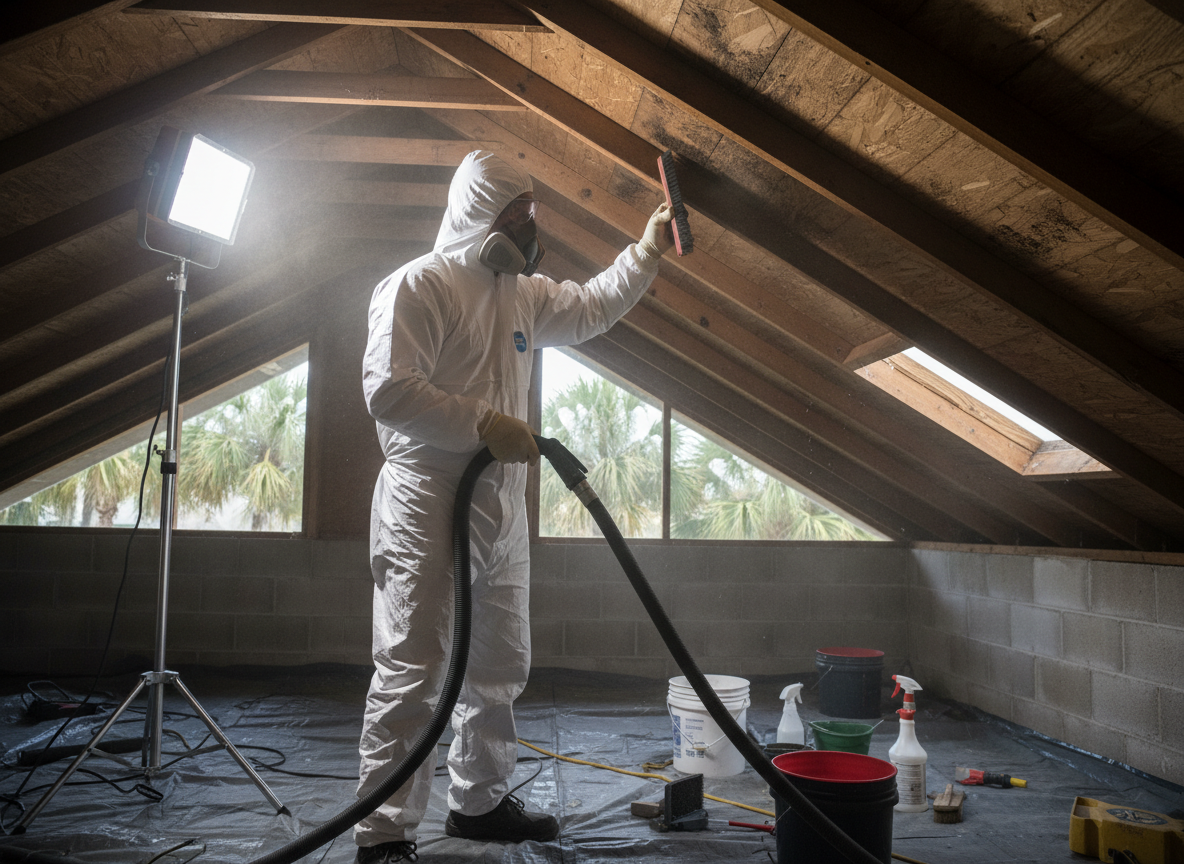
Palm Coast attics in neighborhoods like Matanzas Woods and Indian Trails often develop mold on roof sheathing because the humid subtropical climate creates persistent condensation under shingles during hot summers. Homes here frequently have older rafter systems that trap moisture from mild winters and coastal air moving inland from Flagler Beach, allowing black mold colonies to spread along plywood edges and beam surfaces. Proper removal requires isolating the affected sheathing sections without disturbing sound wood, then applying EPA-registered antimicrobials that penetrate the grain while preserving structural integrity.
Rafter mold in Palm Coast properties near Washington Oaks Gardens State Park commonly stems from inadequate ridge venting combined with tree canopy shade that slows drying after summer rains. Technicians must inspect for hidden growth behind insulation and along collar ties, especially in homes influenced by storm patterns that also affect nearby Daytona Beach and St. Augustine. Edge cases include sheathing delamination where previous leaks have weakened fasteners, requiring selective replacement rather than full deck removal to stay within code limits for Flagler County re-roofing triggers.
Containment protocols for these jobs use negative air machines vented through gable ends to avoid spreading spores into living spaces below. Treatment finishes with borate-based coatings on exposed rafters and sheathing to inhibit future growth without altering load-bearing capacity. Homeowners should expect follow-up moisture mapping because the region's high water table and occasional tropical moisture can reintroduce conditions that favor recurrence if ventilation remains unchanged.
Technician insight
In Palm Coast, the thing that catches most people out with Roof Sheathing & Rafter Mold Removal is how tree cover in Matanzas Woods and Indian Trails traps moisture against the roof deck long after summer storms, letting mold creep under shingles that look fine from the outside until we open the attic.
Sheathing Mold in Palm Harbor Attic
A homeowner in Palm Harbor noticed a musty odor after several humid weeks. Inspection revealed black mold along the north-facing sheathing and lower rafters caused by blocked soffit vents. We contained the space, removed the growth, treated all surfaces, and restored airflow. The attic dried completely with no recurrence during the following mild winter.
Roof Sheathing & Rafter Mold Removal Services We Offer
✓Roof Sheathing Mold Remediation
Removes visible and embedded mold colonies from plywood or OSB sheathing while preserving structural layers in Palm Coast attics.
✓Rafter Mold Extraction
Targets mold growth along rafters and collar ties using contained scraping and antimicrobial application suited to local humidity loads.
✓Sheathing Surface Treatment
Applies penetrating fungicides to cleaned sheathing surfaces to prevent regrowth driven by Flagler County summer condensation.
✓Rafter Reinforcement Assessment
Evaluates and stabilizes rafters compromised by mold before reinstalling insulation in homes throughout Matanzas Woods and Palm Harbor.
✓Attic Ventilation Correction
Improves airflow at ridge and soffit vents to reduce future moisture accumulation common in Indian Trails roof structures.
Roof Sheathing & Rafter Mold Removal Cost in Palm Coast, FL
| Service | Typical Range | What Affects It |
|---|---|---|
| Limited Sheathing Mold Removal | $950–$1,800 | Small isolated patches under 200 sq ft; price rises with access difficulty in vaulted ceilings. |
| Full Rafter and Sheathing Treatment | $2,200–$4,100 | Whole-attic coverage in homes with widespread condensation; affected by insulation removal needs. |
| Sheathing Section Replacement | $1,400–$2,900 | Includes new plywood panels where delamination occurred; varies by roof pitch and debris disposal. |
| Ventilation Upgrade Add-On | $650–$1,200 | Ridge vent or powered fan installation to address ongoing humidity in Matanzas Woods homes. |
Ranges are typical for Palm Coast, FL and confirmed with an exact written quote before any work starts.
How it works
- 1
Initial Containment Setup
Seal the attic workspace with plastic sheeting and negative air machines to prevent spore migration into Palm Coast living areas.
- 2
Detailed Inspection
Map mold extent on sheathing and rafters using moisture meters and borescopes, noting any delamination in older Flagler County homes.
- 3
Removal and Cleaning
Scrape and HEPA-vacuum affected surfaces, then treat with registered antimicrobials while protecting sound wood.
- 4
Restoration and Verification
Apply protective coatings, restore insulation where safe, and confirm dryness levels before reopening the space.
Pricing
Costs depend on attic square footage, mold depth, and any needed sheathing repairs; ranges reflect typical Palm Coast jobs.